
A (De)Glossary of Migration Studies
Authors: Daniela Paredes Grijalva, Federico Besserer, Nick Dreher, Alka Kumar, David Cook-Martín, Luciana Denardi, Jens Schneider, Rosa Aparicio, and Thomas Lacroix
What do we really mean when we say borders, displacement, or citizenship? – and who gets to decide what these words mean?
The (De)Glossary of Migration Studies is a collective experiment and practice to rethink the conceptual language of migration by tracing how key migration terms travel across geographical regions, cultures, histories, and intellectual traditions. Instead of fixing definitions, it asks how meanings are produced, contested and circulated and whose voices are amplified or silenced in the process.
We write in June 2026, in a moment marked by intensified mobility controls, evolving border regimes, and renewed debates about academic inequality, developments that both predate and have been reshaped by the COVID-19 pandemic. Despite its global subject matter, migration studies continue to rely heavily on concepts and authors rooted in a small set of institutions in the Global North. The (De)Glossary responds to this imbalance by paying attention to plural, situated understandings of migration that emerge from around the world.
ORIGINS
It started as an extension of the Syllabi project, but it has taken a life of its own.
The (De)Glossary grew out of the GDC’s Migration Group’s earlier Syllabi Project in 2021. What began as a straightforward effort to map how migration is taught in higher education across different countries quickly revealed something more: syllabi are not neutral teaching tools but archives of epistemic hierarchy.
As we catalogued syllabi from multiple regions and languages, we tracked where courses were taught, which authors they assigned, and which concepts structured their units. This collective, multilingual effort benefited from the group’s diversity and made visible how certain ideas consolidate authority and travel globally, while others remain marginal or invisible. It also showed that some terms often carry very different meanings depending on where they are taught and from which intellectual traditions they emerge.
The (De)Glossary emerged as a way to examine these dynamics more closely — not to standardize meanings, but to trace how they circulate, consolidate, and transform.
WHY A (DE)GLOSSARY?
There are many dictionaries in migration studies. But a dictionary typically implies a centralized authority that determines and stabilizes the meanings of specific words. It aims for closure. A glossary does something different. It gathers terms that matter within a field without pretending they have singular or universal meanings. It highlights how concepts emerge from particular places, histories, and debates. A glossary makes room for plurality.
This distinction became crucial as we compared syllabi and readings. The same keywords —border, citizenship, diaspora, integration— appeared everywhere, yet they did not describe the same realities. Their meanings shifted depending on context, experience, and the questions being asked.
This is why we decided to work with a (De)Glossary; to signal a challenge to a one-word for a concept-one-single meaning approach, with the objective of `decentering’ such an approach. We wanted a tool that could help us explore the situated contexts in which migration concepts emerge and circulate. We became interested in how some terms gain centrality, how they travel from hegemonic settings to subaltern ones, and how scholars and practitioners respond to the weight these concepts carry. This has involved attending to multiple meanings, as well as to how such centrality is contested, rearticulated, or displaced through alternative points of view and forms of conceptual articulation.
The (De)Glossary is therefore not a tool for defining terms, but for opening them up, as well as pointing to how layered they are, and decentering them.
AN ITERATIVE PROJECT
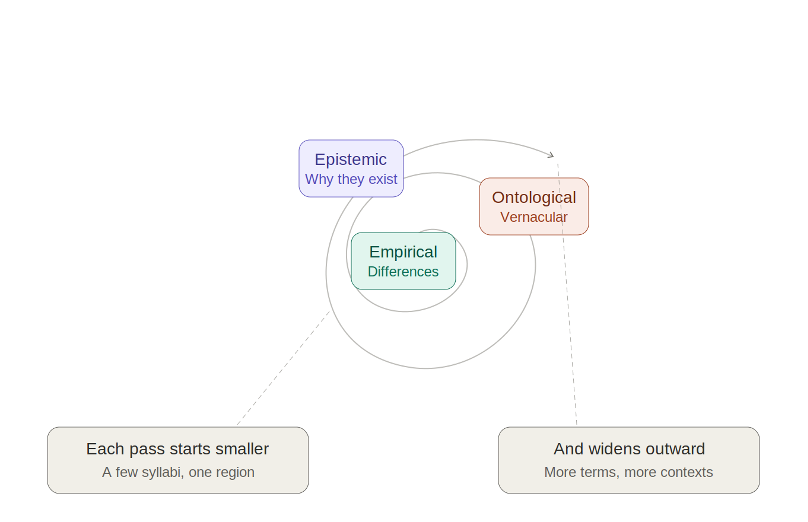
The (De)Glossary is an iterative project. Rather than compiling fixed definitions, our work moves in cycles — identifying terms, comparing their uses, tracing their trajectories, and returning to the field where new meanings continue to emerge. To make this ongoing movement visible, we describe it through three interrelated strategies: an empirical step, an epistemic step, and an ontological step. These are not stages to complete but orientations we revisit as the (De)Glossary evolves.
STRATEGY 1: The empirical step
We begin by looking into our collected material identifying concepts that recur across the syllabi and appear central to how migration is taught. We then turn to the readings assigned in each course to see how these concepts are used and interpreted. We found that the intellectual and empirical contexts in which concepts such as “border” are used vary significantly. For instance, the notion of “border” in South American scholarship differs substantially from its treatment in literature focused on the northern border of Mexico with the United States. These divergences reveal how concepts travel unevenly and acquire distinct contours across regions.
This first strategy was not oriented toward identifying similarities, but rather toward foregrounding differences. The central question guiding this strategy was whether it would be possible to decenter authorized definitions of key concepts by contrasting them across global contexts—approaching meanings as networks rather than as fixed platforms.
STRATEGY 2: The epistemic step
Looking at syllabi from around the world was not enough. The geographical origin of the syllabi did not always lead to alternative definitions, as the Syllabi Project itself made evident. Certain “mainstream” or canonical authors recur across syllabi from very different regions, suggesting not only the persistence but also the dominance of shared conceptual frameworks despite geographical variation. There is an embedded sense of `authoritativeness’ in meaning-making in such a conceptualization that this project intends to reveal and challenge.
This realization led us to identify several complementary tactics of inquiry. So an alternative of looking through the lens of “where geographically did this syllabi or this concept originate from,”we asked “what intellectual traces does it have” and “which intellectual tradition is this concept emerging from ?” We might identify texts and concepts from different areas and regions in the world that “work” across contexts and regions – but we are also looking for the situatedness of knowledges. In this second strategy, we shift from comparing uses of concepts to examining the forms of knowledge that make those uses authoritative. We ask how particular interpretations emerge, which intellectual traditions they draw on, and how they come to shape what we teach in migration studies. First, we trace concepts that emerge from reading programs and intellectual traditions in the Global South, identifying locally grounded categories and problematics rather than assuming conceptual dependence.
A second tactic draws on critical currents that have emerged from within and around migration studies. This includes work informed by feminist, postcolonial, and cultural theory that challenges dominant conceptual frameworks from inside the field, as well as approaches such as diaspora and transnational studies that push beyond the field’s conventional boundaries by decentering the nation‑state and proposing alternative analytical tools.
Taken together, these strategies point toward the production of an alternative conceptual repertoire: an effort to think beyond existing frameworks by proposing new terms and categories capable of grasping contemporary realities. This would take the form of an explicitly critical “(De)Glossary.”
STRATEGY 3: The ontological step
Is reflexivity alone enough to move beyond hegemonic thinking in the field? Or does it risk reproducing them at another level? This leads us to consider the status of the vernacular ways in which the people we work with understand and describe their worlds. Very often, significant advances within the discipline have emerged from a careful engagement with vernacular language. Terms coined by migrants such as “Neza-York”—used by migrants from Ciudad Nezahualcóyotl in Mexico to refer to New York as a transnational, or “third,” space they inhabit—have disrupted conventional disciplinary modes of naming. This playful vernacular toponymy, emerging from migrant experience does not merely describe the world, it challenges the epistemic authority of academic language by foregrounding situated forms of knowledge and experience. We include such terms within our “(De)Glossary,” incorporating them into an effort to decenter androcentric, Northern-centric, and more established disciplinary frameworks in our understanding of the contemporary world.
{See the test preliminary entry on borders}
WHERE WE ARE HEADING
Our next step is to continue the collection of Migration Studies syllabi from across the world. The broader and more diverse the corpus, the more the (De)Glossary can challenge dominant frameworks and foreground situated forms of knowledge.
As we move forward, the work will remain a process of learning and unlearning, as well as shared thinking and collective writing, including to signal an elastic movement of decentering and recentering as new materials shift the ground beneath our concepts. Each addition stretches the project, asking us to rethink what we thought we knew and to practice the kind of southern attitude and conceptual flexibility that the (De)Glossary itself seeks to embody and cultivate. This work can only continue through collective participation.
A CALL FOR ACTION
Do you teach a migration studies course?
We welcome syllabi from any region, language, or disciplinary background. Sharing your materials helps us build a more global and heterogeneous archive.
Interested in collaborating with us?
We are developing multiple forms of participation—research collaborations, short‑term internships, and opportunities to contribute entries to the (De)Glossary. Information about these possibilities will be posted on our website.
To get involved, reach out to Migration Working Group coordinators. We look forward to expanding this collective project with you.